

BLUF (Bottom Line Up Front)
Senegal is navigating a complex period marked by an internal power struggle between President Faye and Prime Minister Sonko, significant economic challenges due to a revealed “hidden debt,” and an elevated regional diplomatic profile with its recent election to lead the ECOWAS Commission. The government is pushing forward with economic reforms and national sovereignty initiatives, while facing scrutiny over fiscal stability and internal political cohesion
Operational Timeline
- December 9, 2025:
- President Bassirou Diomaye Faye presided over the opening of the 4th MSGBC Oil, Gas and Power 2025 conference in Dakar.
- A working visit by the UAE Minister of Foreign Trade to Senegal commenced, concluding on December 10, 2025, and resulting in new investment partnerships.
- President Faye appointed Vice Admiral Oumar Wade as the new Chief of the General Staff of the Armed Forces, effective February 12, 2026.
- December 10, 2025:
- Senegal approved its share of payment for the proposed African Energy Bank (AEB), with payment expected before the end of 2025.
- December 11, 2025:
- The Council of Ministers, chaired by President Faye, focused on stabilizing and transforming the higher education sector, including calls for systematic audits of university expenditures and resources.
- President Faye announced his scheduled participation in the ECOWAS Summit in Abuja, Nigeria, on December 14, 2025.
- December 12, 2025:
- Reports emerged indicating that Senegal’s short-term commercial loans were being offered at steep discounts, signaling mounting concerns among finance industry sources regarding the country’s ability to meet its financial obligations. This follows the revelation of over $11 billion in previously unreported debt.
- December 13, 2025:
- The 2026 budget for the Ministry of Economy, Plan and Cooperation, totaling 39.3 billion FCFA, was adopted by the Commission of Finance and Budgetary Control, with debates focusing on the country’s financial situation and public debt.
- Regional Event: Jeune Afrique reported on an attempted coup in Benin on December 7, 2025, with the alleged mastermind, Lieutenant-Colonel Pascal Tigri, reportedly on the run since December 10, 2025.
- December 14, 2025:
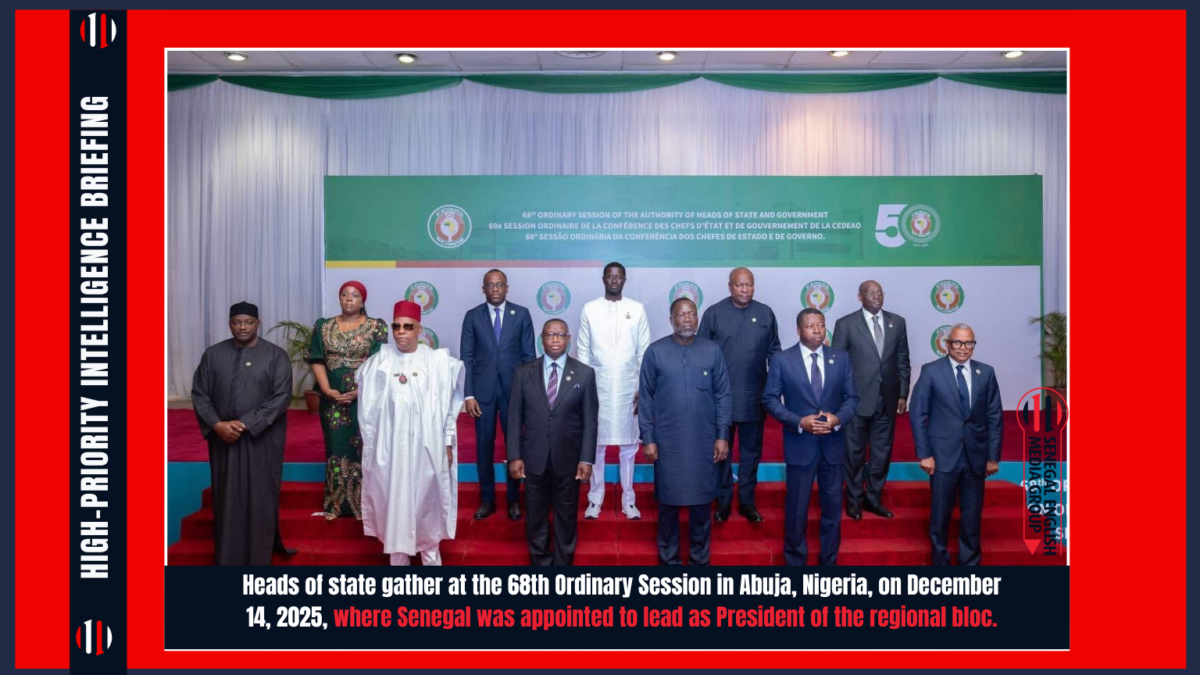
- Senegal was elected to lead the Commission of the Economic Community of West African States (ECOWAS) for the 2026-2030 term. The decision was made during the 68th Ordinary Session of the Conference of Heads of State and Government in Abuja, Nigeria.
- Bloomberg Markets reported that Senegal intends to tap West Africa’s regional debt market to finance its 2026 budget deficit, as the country has been effectively shut out of international markets due to the discovery of billions in unreported borrowings.
- December 15, 2025:
- Senegal’s international bonds experienced a decline following weak demand at a regional debt auction held the previous week, despite increased interest rates.
- ARTICLE 19 Senegal and West Africa called on governments across Africa to urgently strengthen the African Union Convention on Ending Violence Against Women and Girls, particularly to address technology-facilitated violence.
- A new center for agricultural mechanization officially opened in Podor.
- The Senegalese national football team began its training camp in Dakar in preparation for the upcoming CAN 2025 tournament in Morocco.
- December 16, 2025 (CURRENT DATE):
- President Faye inaugurated Senegal’s first military vehicle assembly plant (ISEVEM) at the Diamniadio industrial platform, a public-private initiative aimed at enhancing defense autonomy.
- The World Organisation for Animal Health (WOAH) indicated that Rift Valley fever outbreaks across Senegal, Mauritania, and Gambia, which intensified following heavy rainfall in September 2025, appear to have peaked, with case numbers now expected to decline.
Conflict Matrix / Key Actors
- Government (President Bassirou Diomaye Faye & Prime Minister Ousmane Sonko Administration):
- Stance: Focused on economic sovereignty, fiscal consolidation, higher education reform, strengthening defense capabilities, and enhancing regional diplomatic influence.
- Actions: Inaugurated the military vehicle plant, appointed a new Chief of General Staff, participated in the ECOWAS Summit, discussed educational reforms, and launched the “Sunu Champion” economic initiative.
- Opposition:
- Stance: Critical of the government’s economic management and alleged threats to democratic values, as evidenced by the formation of the “Front for the Defense of Democracy and the Republic (FDDR)” in February 2025.
- Actions: Opposition parties and civil society continue to monitor government actions and advocate for transparency and accountability. Student protests occurred earlier in December 2025 due to unmet financial aid demands.
- Civil Society & Unions:
- Stance: Advocates for human rights, civic freedoms, and addressing social inequalities.
- Actions: ARTICLE 19 Senegal and West Africa campaigned for stronger protections against technology-facilitated violence, particularly targeting women and girls.
- International Monetary Fund (IMF):
- Stance: Its $1.9 billion program with Senegal remains frozen due to the discovery of significant unreported debt from the previous administration. The IMF is cautious regarding Senegal’s ambitious budget forecasts and calls for debt restructuring.
- Actions: Engaged in ongoing, albeit slow, talks with the Senegalese government for a new financial program.
- Regional Investors/Creditors:
- Stance: Demonstrating caution due to concerns over Senegal’s debt burden and its capacity to meet financial commitments.
- Actions: Exhibited weak demand at recent regional debt auctions, leading to a drop in the value of Senegal’s international bonds.
- ECOWAS (Economic Community of West African States):
- Stance: Aims to promote economic integration and maintain peace and stability in the sub-region.
- Actions: Elected Senegal to lead its Commission for the 2026-2030 term, entrusting Dakar with a significant regional leadership role.
Source Divergence
- Government vs. Opposition on Internal Cohesion and Authority: A notable divergence has been reported concerning an alleged power struggle that “erupted” in December 2025 between President Faye and Prime Minister Sonko. This was reportedly triggered by President Faye’s unilateral decision to remove Aïssatou Mbodj, a key Sonko ally, from the leadership of the “Diomaye Président” coalition. Sonko’s Pastef party subsequently issued a statement rejecting the president’s authority to make such a change, asserting that Faye “does not have the power to dismiss” Mbodj and indicating a “deep ideological and political rift within the government.”
- Current vs. Former Administration on National Debt: The Faye-Sonko administration’s audit of state finances (released February 2025) revealed a total outstanding debt of approximately $28.55 billion by December 31, 2023, representing 99.67% of GDP, a significant increase from the 74% reported by the previous Macky Sall government. This audit indicated that a substantial proportion of debts were contracted outside official budgetary frameworks, pushing the current debt-to-GDP ratio above 119-132% by end-2024. Former President Macky Sall, however, rejected accusations of corruption and budgetary opacity, labeling them “political theatre” and asserting that the audit court had certified state accounts annually. The IMF has supported the current administration’s view, stating that reports “clearly showed there was an explicit intention to hide these debts.”
Strategic Forecast
- Political Dynamics: The reported power struggle between President Faye and Prime Minister Sonko will be a critical internal dynamic to watch in the coming weeks. Its resolution or continued tension could impact the effectiveness and stability of the ruling coalition, potentially diverting focus from key governance priorities.
- Economic Stability: Senegal’s immediate economic outlook remains precarious due to its substantial debt burden and the lack of a resumed IMF program. The government’s strategy to rely on regional debt markets may offer short-term relief, but significant structural reforms and fiscal consolidation will be necessary to restore investor confidence and long-term sustainability. Public discontent, particularly among students, may resurface if economic hardships persist.
- Regional Leadership: Senegal’s new role at the helm of the ECOWAS Commission offers an opportunity to assert stronger diplomatic leadership in a turbulent West African region. President Faye is likely to leverage this position to advocate for stability, economic cooperation, and potentially mediate ongoing regional crises, such as the coup attempt in Benin.
- Sovereignty Agenda Progression: The inauguration of the military vehicle assembly plant and the impending complete withdrawal of French troops by year-end underscore the Faye administration’s commitment to reinforcing national sovereignty. Further initiatives aimed at enhancing self-reliance in defense, economy, and technology are anticipated as part of the “Senegal 2050” vision.
SENEM GROUP Intel